
By Roy Mathur, on 2021-11-10, at 22:53:57--23:45:29, for Captain Roy's Rocket Radio Show, Listen
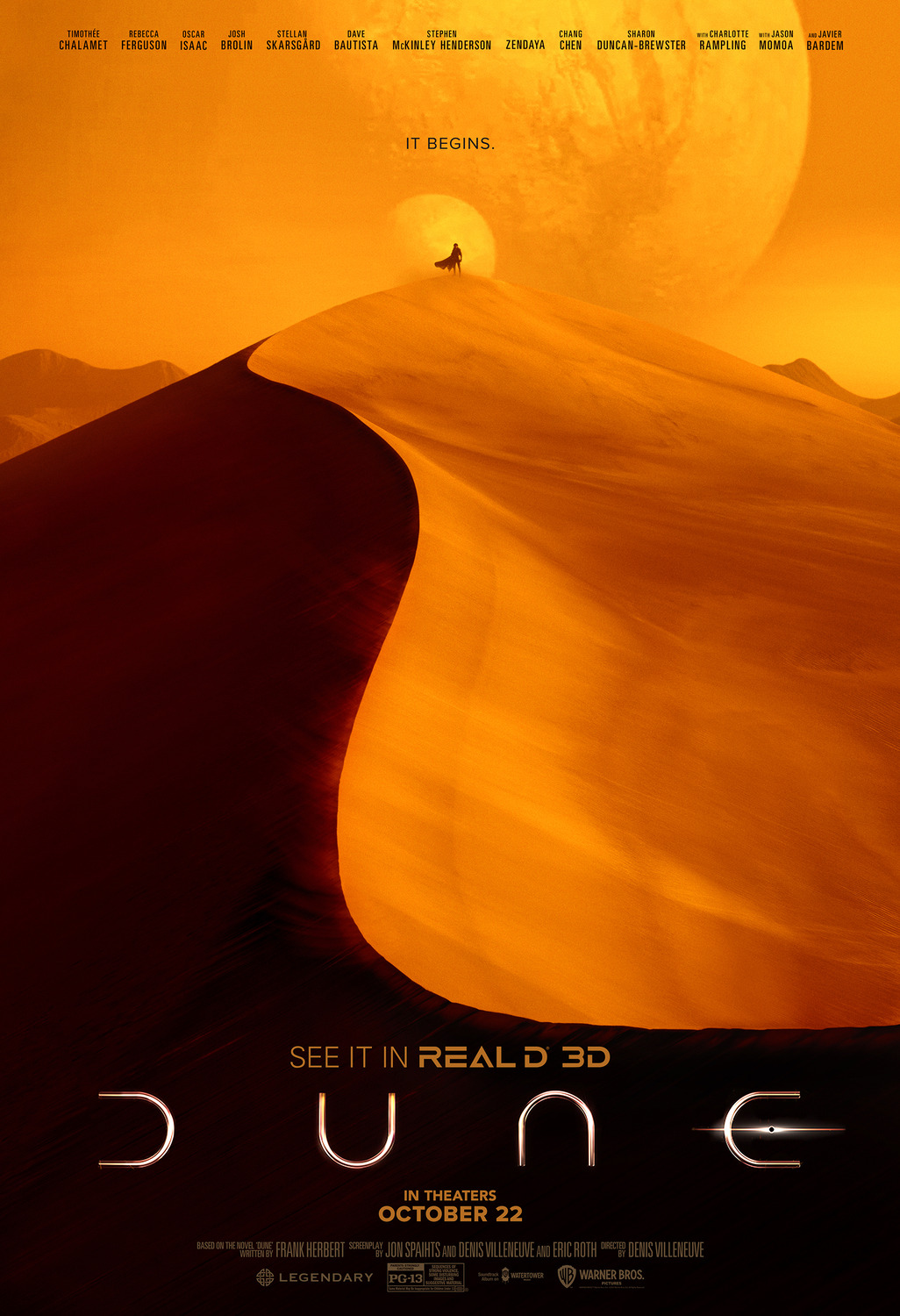
This is an extremely spoiler-ridden review, not just of Denis Villeneuve's adaptation of the first half of the Frank Herbert book, but much of the Dune saga. You have been warned.
Directed by Denis Villeneuve and starring Timothee Chalamet (Paul), Rebecca Ferguson (Jessica), Oscar Isaac (Leto), Josh Brolin, (Gurney), Stellan Skarsgard (Baron Vladimir Harkonnen), Dave Bautista (Rabban), Stephen McKinley Henderson (Thufir Hawat), Zendaya (Chani), Chang Chen (Doctor Yueh), Sharon Duncan-Brewster (Doctor Liet Kynes), Charlotte Rampling (Reverend Mother Gaius Helen Mohiam), Jason Momoa (Duncan Idaho), Javier Bardem (Stilgar).
What makes the Dune universe different from the other sprawling science fiction/fantasy epics, like Foundation or Star Wars, is that Dune is a spiralling tragedy. The situation never improves, despite people with noble intentions, incredible technology, and a vast, powerful interstellar empire. All is doomed. If there was ever a paean to the dangers of unrestrained capitalism and imperialistic hegemony, it is Dune.
I have read all the way the Frank Herbert books, Dune, Dune Messiah, Children of Done, and God Emperor when I was a teenager. However, I can only say that I'm only truly a fan of the first two books, which follow the journey of Paul, and which I have read several times. The story doesn't degrade in the later books, but I invested so much in Paul, that the later story holds little interest for me.
I have also seen the David Lynch movie numerous times, as well as the Hallmark TV show once, and earlier today, the documentary about ambitious, though unmade, Dune film by Chilean artist and filmmaker, Alejandro Jodorowsky. Though enjoyed them all and appreciated the artistic interpretations, I feel they are but pale reflections of the Dune and Dune Messiah novels. So how does this latest film fare?Paul Atreides, a teenager and heir apparent to one of the rich and powerful aristocratic houses that control the known universe under the leadership of the Padishah Emperor, and his family are given the opportunity to rule the source of the universe's power. That is a planet called Arrakis, or more colloquially, Dune. The arid planet is mined for spice which enables long life and interstellar navigation. This promotion is, however, a ploy to allow the former rulers, the Harkonnen's; a rival house, to ambush the Atreides, thereby eliminating competition to the Padishah Emperor's power. In another words, the Emperor conducts a proxy war, in order to keep his hands clean, with an assault disguised as internecine warfare.
During the course of the film, Paul and his family leave their peaceful former home, Caladan, assume the rulership of Dune, and are almost immediately attacked. Paul's father dies, and he and his mother escape into the sandy wastes. Avoiding the native giant sandworms, they are allowed to join the native Arab-like Fremen, after a lethal trial by combat.
That's the dried and desiccated bones of the story, now let me tell you what I thought.
Let's talk casting. Diversity is terrible. We are on an arid desert world of a far-future planet sparsely populated by a heavily Arab influenced culture and there does not appear to be a single Arab in the main cast. The casting decisions also bemused me. Why is Josh Brolin, Gurney, and Dave Bautista, Rabban? I think the roles should have been reversed. Bautista is a muscle-bound lump of a man, but very charismatic. Who does that remind readers of the book of? Rabban is a nasty bastard, and there's something vain and egotistical about Josh's screen presence that would suit the Harkonnen demeanour. In fact, diversity aside, I don't have any other substantial complaints about the main cast in general, and compliment Stellan Skarsgard, who is terrifying as Baron Vladimir Harkonnen.
Doctor Liet Kynes is one of my favourite characters; a person balancing on the very crysknife edge of two very different worlds. In this film he is mildly gender-bent to be played by a female, which is absolutely fine, but he's a fairly minor character. You know what I would have done? While Momoa does a fine job, I'd have cast Duncan as a woman. If you read the books, you'll know that would oddly suit his biological destiny as a clone. Why not make the original versions a woman, then the first clone played by Jason Momoa?
Why do the Harkonnens and their household all have shaved heads? Alright, in the David Lynch movie, it was red hair, but what is the point in repeating this clumsy visual shorthand? Also, did the Baron remind you of Colonel Kurtz from Apocalypse Now? Me too.
This is a very straight adaptation from the book. I would say it remains overly faithful to the book. While the medium of film is used to create epic and beautiful sea, space, and desertscapes, it is not used in a way that could have enhanced the novel and created a truly unique film. For example, Paul is born on the sea-world of Caladan. Setting aside that we see no boats, ships, ports, in fact, Caladan appears wholly unpopulated with native peoples, and there is no evidence of the Atreides so-called "sea-power", how is Paul's strong tie to his ocean-world home shown before he leaves forever? He goes for a stroll on the beach. Why doesn't he go for a last swim, or paddle, or sail? Why does he not take a keepsake to remember his home; perhaps a seashell, or even a canoe that he could pack away with his belongings, unpack on Arrakis, then later stare at wistfully? Or perhaps a last silent encounter with friends; teenagers will always find a way. Those things would not have required adding to the dialogue, nor would they have substantially changed, or detracted from the story. On the contrary, a little exercise in creativity would have made for a better overall movie. Instead, we got this lovely, but unimaginative adaptation.
On the other hand, the realisation of the universe was generally great, though I do wish I'd seen more of the vast Spacing Guild's heighliner ships. I loved the dragonfly-like ornithopters. I loved the awesome majesty of the sandworms; all praise the Great Maker, Shai-Hulud!
I thought the Sardaukar combat scenes were silly. The Padishah Emperor's shock troops/commandos descend to attack, SAS-like, on suspensor belts. Aren't they sitting targets, like big turkeys, when they do that? Sure, everyone has Holtzman shields, so can't be shot, but at the moment of landing they are vulnerable.
I liked the actors playing Mentats, but why do their eyes have to roll up every time they run calculations. I used to do that, and let me tell you all that happens is that you are ridiculed. I much preferred the Sapho-stained lips of Mentats in Lynch's Dune, though the old man eyebrows were a little odd.
There have been some comments about how the terminology of the Dune universe isn't explained well in the film. I'm glad of that, as there're nothing worse than clumsy exposition. I think what we need to know is explained as much as it needs to be, but then I would say that as a fan familiar with the material.
What the hell was the Baron's weird spider-humanoid pet/gimp? Was it a stylistic nod to the late Swiss artist H.R. Giger, who worked on the unmade Jodorowsky Dune film, David Lynch's Dune, Alien, etc.? His idiosyncratic biomechanical horror erotica can certainly be seen in the creature design of the scuttling, shiny shiny, slick, black thing.
I like the film, but I'm disappointed that it took no risks and played it safe. I was expecting great things, using the unique medium of film, but only got what was already there. I'm reminded of Peter Jackson's equally risk-averse, The Hobbit and The Lord of the Rings. (Okay, apart from the disastrous frame rate changes of The Hobbit, but that's technical risk-taking, not narrative). The books, Dune and Dune Messiah, are not perfect. There are many loose ends and plot holes. I wish the film addressed some of those, as well as adding a little of the Villeneuve auteur flare through visual storytelling, in the ways I suggested. The movie is, however, evocative and epic and captured the grand scale vistas.
Diversity aside, I also generally liked the main cast.
I liked the portrayal of a far-future technology: high-tech, but without computers. All the fan favourite moments are there: the Bene Gesserit's Kwisatz Haderach test and the litany against fear, the confrontation between the Baron and the Duke, the fight with Jamis, the fantastic and awesome majesty of the sandworms, and oh, those lovely ornithopters.
I look forward to the next film, but hope there is a third so that Dune Messiah is included. Without that, Paul's arc is incomplete.
Much as I don't generally like gloomy, doomy, sci-fi dystopias, the Dune universe is the perfect warning against hereditary hegemony, imperialism, despotism, fundamentalism, and unfettered capitalism. It's fatalistic, but still relevant today as it was in the 60s, and yet somehow manages to be engaging despite the pessimism. Do we really want to wake up to a world of untouchable, entitled, super-rich influencing every aspect of our lives? Oh...
Friend of the show, @sgarnell, on 2021-11-08, Tweeted at me:
Dune .....yeah it was good but I felt it dumbed down the story and replaced narrative with cinematic eye candy. A well made film no doubt but missing some of the details and plot complexity that makes Dune unique.
It's funny. Either you're too close or too far from the narrative. Dune is a hard one to do because it's narratively too philosophical for modern film more focused on whammies; sex and violence. Visually, it's expensive to make because of its epic nature.