
By Roy Mathur, on 2021-12-29, at 23:00:00--23:37:14 GMT, for Captain Roy's Rocket Radio Show, Listen
Incredibly, it's still going. I'm painfully aware there're still 11 years of stories yet to revisit.
When this hellish campaign is over, I'll deserve a medal, or a straitjacket.
A couple of hours ago I took Mum and Dad out to see the Christmas lights. There were none in town. COVID? At least we had a little family drive and saw the lights around people's houses in the neighbourhood.
Fourth Doctor: Tom Baker
Companion(s): Romana: Mary Tamm, K9: John Leeson
Director: Michael Hayes (three Doctor Whos, including City of Death)
Writer: Bob Baker and Dave Martin (Baker and Martin writing partnership for several Doctor Whos, Baker was also co-writer of the Wallace and Gromit films).
Producer: Graham Williams and David Maloney (uncredited, also directed several Doctor Whos, and Blake's 7s, which he also produced for the first three seasons)
Location: In studio only.
Broadcast: Story 103/serial 6 (final) of season 16, 6 x 25 minute episodes, 20 January--24 February 1979, following The Power of Kroll covered in pod 418.
Singer, Will Young was born in Wokingham.
We open with a hammily acted video propaganda piece broadcast to a heavily bombarded casualty ward.
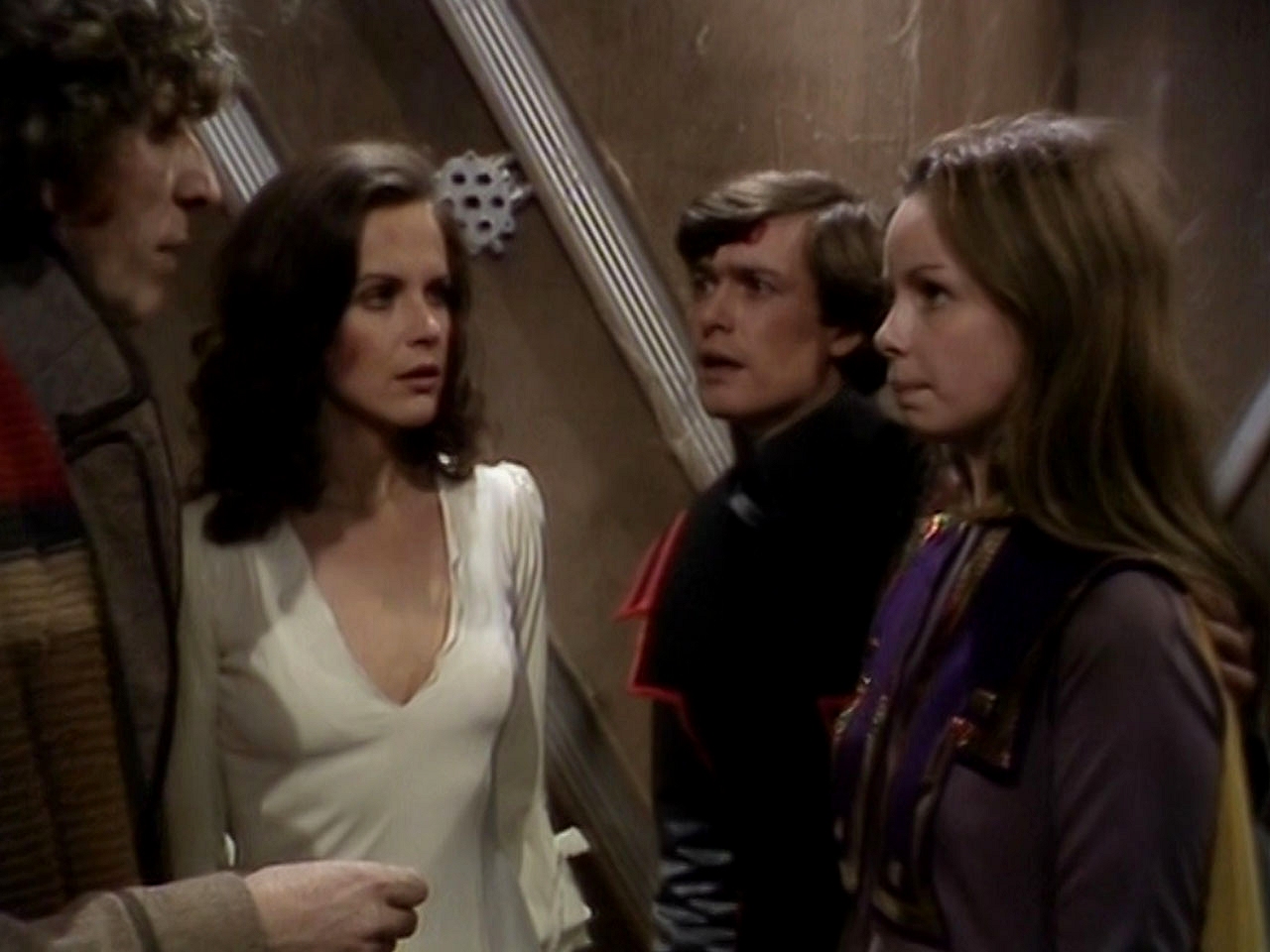
In the TARDIS, Romana, the Doctor, and K9, in their quest for the sixth and final segment of the crystalline Key to Time, arrive on the war-torn world of Atrios, in the final leg of an atomic war its neighbour, Zeos.
Princess Astra and her allies want peace, but she is merely a puppet ruler under the thumb of the unstable Marshal. Tiring of her meddling, he attempts to dispose of her permanently by locking her in a heavily irradiated abandoned part of the complex. She is later kidnapped by mysterious black-clad henchmen.
After initially being framed for the murder of a guard, the Doctor and his companions follow Astra, who they think is connected to the sixth piece of the Key, to Zeos via a secret matter transportation system.
The increasingly crazed Marshal personally leads a bombing raid on Zeos, which triggers the Zeos military computer to begin a countdown to self-destruction. The Doctor temporarily jury-rigs and activates the five parts of the Key to Time, creating a time loop to suspend the oncoming disaster.
Astra is the sixth segment, but to complete the Doctor's mission for the White Guardian, she must lose her life. The evil Black Guardian's diabolical servant, the Shadow, forces her to change into the final piece of the Key, but it is almost immediately stolen by the Doctor and taken into the TARDIS.
On board, the White Guardian demands the Key. The Doctor is suspicious of his callous behaviour. The suspicion is proven correct, when the face on the display changes to that of the Black Guardian. The Doctor disperses the segments and they are lost, though the sixth transforms back into Astra.
The Doctor installs a randomising device into the TARDIS's navigation controls, so that their onward journey cannot be predicted by the Black Guardian.
The camera pulling out from opening propaganda video to the casualty ward, i.e. film within film within film, seemed very like a Russian Matryoshka doll.
Given vintage Doctor Who's admirable social conscience, though also occasionally appalling lack of thought in portraying people of colour, I was worried about how the Black Guardian and his nasty servant, the Shadow, would look. Mavic Chen (pod 50), anyone? I needn't have worried. The Black Guardian was simply white actor Valentine Dyall, as a negative film version of the White Guardian, while the Shadow was another white actor under matt greyish and rubbery makeup.
The Black Guardian's servant, the Shadow, resembles Swarm from the latest season 13 of New Who; Doctor Who: Flux. He also a similar desire for mass-destruction. Flux is also the only other season-spanning story. That cannot be a coincidence. Chris Chibnall, did this story influence you?
The war-mad Marshal is played by John Woodvine. He went on to play a similar character (Prior Mordrin), wearing an admittedly more utilitarian, though similarly fascistic uniform and crest in ITV's Knights of God (1987). The Marshal's militaristic video broadcasts to the population and the accompanying trumpet fanfare also echo the later series.
The Atrian troops' jackboots looked like wellies. Budget?
During the closing part of the adventure, the Doctor allies himself with Drax. Latterly from Brixton, this annoying geezer-type spiv, in a shell suit no less, is also a Time Lord. The intergalactic chancer is an old classmate of the Doctor, who dropped out of the Time Lord Academy. He picked up a strong London accent while in prison for crooked wheeler-dealering. We also learn, from an interchange between the two, that the Doctor is, in fact, allowed that title as he was awarded a doctorate for his studies.
Princess Astra and future Romana, Lalla Ward, is in the same story as the current Romana, Mary Tamm. I prefer Mary Tamm's version of the character.
M.A.D. (Mutual Assured Destruction) is such a relevant theme to the Cold War period during which this story was filmed, as is the idea of old warmongering hawks, like the Marshal, versus young doves, like the peacenik Astra and her physician boyfriend. I hated the Cold War and MAD. While militaries promoted the crazy idea of nuclear detente, people my age remember the nightmarish Protect and Survive leaflets.
There is a hilarious dialogue between the Doctor and his companions.
Doctor: Where's your optimism?
Romana: It opted out.
K9: Optimism: a belief that everything will work out well; irrational, bordering on insane.
The humour reminds me of Blake's 7's Orac's acerbic wit, as well as Vila's masterful description of sinister architecture as, "reminiscent of early maniac." Alright, that was tangential, possibly irrelevant, but I couldn't resist referencing Blake's 7.
Romana says that the identification dialogue between K9 and the Zeon's Mentalis military computer is like the dance of the bees. I'm not one of those nerds who loves correcting people, but this leapt out at me. This is incorrect. The waggle dance is used to communicate the location of food sources between the worker bees of a colony. Nerd.
Douglas Adams was one of the script editors.